
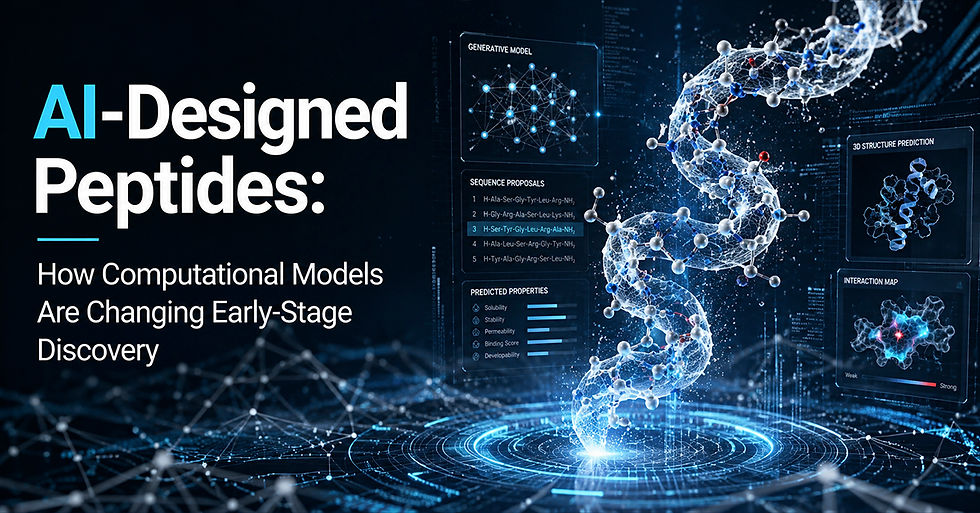
AI-Designed Peptides: How Computational Models Are Changing Early-Stage Discovery
- May 9
- 8 min read
Updated: May 11
Peptide research is entering a new design era.
For decades, early-stage peptide discovery depended heavily on biological screening, natural sequence exploration, structure-activity relationship studies, and iterative laboratory testing. Those methods are still important. But they are now being joined by a powerful new set of tools: artificial intelligence, machine learning, deep generative models, structure prediction systems, and data-driven optimization workflows.
The result is not a replacement for laboratory science. It is a different kind of discovery loop.
Computational models can help researchers explore enormous peptide sequence spaces, prioritize candidates, predict structural behavior, evaluate binding hypotheses, and refine experimental strategies before molecules are synthesized. Wet-lab validation remains essential, but AI is changing what happens before the first batch is made.
This article is not about personal use, wellness trends, or therapeutic claims. It is about the research landscape: how computational models are changing early-stage peptide discovery and why the peptide industry is paying close attention.
Why Peptides Are Well-Suited to Computational Design
Peptides are sequence-based molecules. That makes them naturally attractive for computational research.
A peptide’s amino acid sequence can be represented as data. Its structure can be modeled. Its properties can be predicted. Its variants can be generated, ranked, filtered, and compared. In theory, that makes peptides an excellent fit for machine learning.
The challenge is scale. Even a short peptide can have an enormous number of possible amino acid combinations. As sequence length increases, the design space becomes too large for traditional trial-and-error methods.
AI can help narrow that search space.
Recent reviews describe AI as an increasingly important direction in peptide-based drug design, especially through deep generative models that can design target-specific peptide binders. However, they also emphasize that computational peptide design remains difficult because peptides are flexible molecules and can require substantial computational resources.
That tension is what makes the field so interesting. Peptides are highly designable in concept, but difficult in practice.
From Searching to Generating
Traditional discovery often begins with the question: What can we find?
AI-assisted discovery increasingly asks: What can we generate?
Generative models can propose new peptide sequences based on patterns learned from existing datasets. Instead of screening only what is physically present in a library, researchers can use models to explore possible sequences that may not have been synthesized before.
A 2026 review on peptide-based drug design using generative AI noted that recent advances have shifted attention toward structure prediction, generative design, and interaction modeling. It highlighted graph neural networks, transformers, and diffusion models as tools being used to generate novel sequences, while also noting that predicting solubility, immunogenicity, and toxicity remains challenging.
For early-stage discovery, that matters because the research workflow can become more directed. Instead of making and testing thousands of random or semi-random sequences, a team may use computational models to prioritize a smaller set of candidates for synthesis and evaluation.
The lab does not disappear. It becomes part of a tighter feedback loop.
The New Discovery Loop
AI-designed peptide research often follows a cycle:
A model proposes sequences.Researchers synthesize selected candidates.Assays generate experimental data.The data are fed back into the model.The next round of candidates becomes more informed.
This loop is especially powerful when paired with high-throughput synthesis and screening. A 2025 industry article described the value of quickly converting AI-designed sequences into physical molecules through high-throughput peptide synthesis and biological testing, allowing iterative optimization of the model.
The keyword is iterative.
AI does not need to be perfect in the first round. Its value often comes from helping teams learn faster across multiple rounds of design, synthesis, testing, and analysis.
Structure Prediction and Binding Models
Peptide discovery is not only about sequence. It is also about shape.
Peptides can be flexible, dynamic, and context-dependent. They may adopt different conformations depending on solvent, target, modifications, cyclization, or formulation environment. That makes structure prediction difficult, but also important.
Computational models are being used to study peptide conformations, target interactions, binding pockets, and molecular recognition. In macrocyclic peptide research, for example, AI-guided design has become especially active because ring-shaped peptides can be engineered to hold more defined conformations.
The University of Washington’s Institute for Protein Design introduced RFpeptides as a deep-learning approach for designing macrocyclic peptides that bind target proteins using target structure or sequence information. The group described this as a departure from traditional approaches that require extensive screening of vast peptide libraries.
This type of work suggests a future where target structure, peptide design, and experimental validation become more tightly integrated.
Machine Learning for Optimization
Early-stage peptide discovery is rarely about optimizing one property.
A research candidate may need to be evaluated for binding, selectivity, stability, solubility, synthesis feasibility, aggregation tendency, permeability-related properties, formulation compatibility, and analytical behavior. Improving one feature can sometimes worsen another.
This is where machine learning becomes especially useful. Models can help researchers explore multi-parameter optimization, where the goal is not simply “best binding” but a more balanced profile across several research-relevant criteria.
A 2024 paper on machine-learning-guided peptide discovery described a platform combining large peptide libraries, synthesis, screening, and ML-driven analysis. The authors noted that ML-enabled QSAR approaches have shown promise in small-molecule discovery but have faced challenges in peptide discovery because of limited data availability.
That point is important. Peptide AI is not just about algorithms. It is about data.
Without high-quality experimental datasets, even sophisticated models can struggle.
The Data Problem
AI systems learn from data, and peptide data can be messy.
Datasets may be small, inconsistent, proprietary, assay-specific, or difficult to compare across studies. Peptides may include non-natural amino acids, cyclization, stapling, lipidation, conjugation, terminal modifications, or other chemical features that are not always represented consistently in standard datasets.
This creates several challenges:
How should peptide sequences be encoded?How should modified residues be represented?How should negative results be included?How can models learn from small datasets?How can assay context be captured?How can models avoid memorizing bias from existing libraries?
A 2025 review of deep generative models for therapeutic peptide discovery highlighted the importance of relevant databases, data representation, and optimization of how peptide information is encoded for model training.
In other words, the future of AI-designed peptides depends not only on model architecture, but also on better data infrastructure.
De Novo Peptide Sequencing and Discovery
AI is also influencing peptide identification.
Deep learning-based de novo peptide sequencing uses mass spectrometry data to infer peptide sequences without relying entirely on database matching. This is relevant to proteomics, natural peptide discovery, and peptide identification workflows.
A 2025 systematic review on deep learning-based de novo peptide sequencing described the field through data types, model architectures, decoding strategies, applications, and evaluation metrics, while identifying key challenges and future research opportunities.
This is a different but related part of the AI-peptide ecosystem. AI can help design new peptides, but it can also help identify peptides from complex biological data.
Together, these capabilities support a broader transformation: peptide research is becoming more computational from both directions — discovery and analysis.
AI and Antimicrobial Peptide Research
One visible area of AI-peptide work is antimicrobial peptide research.
Researchers are using computational methods to mine biological datasets, identify candidate sequences, and explore the chemical diversity of natural and synthetic peptides. A 2024 Guardian report described a study using machine learning to identify nearly one million potential antibiotic-like molecules from global microbial diversity, while noting that the work remained early and required further investigation before any clinical pathway.
This example shows both the promise and the caution required.
AI can help researchers scan massive biological datasets much faster than traditional approaches. But candidate identification is only the beginning. Experimental validation, safety evaluation, mechanism studies, synthesis, formulation, and regulatory review remain essential.
For an industry publication, this is the responsible framing: AI accelerates hypothesis generation, not final answers.
Where AI Helps Most in Early-Stage Discovery
AI-designed peptide workflows are most valuable in the early stages of research, where the goal is to explore possibilities, reduce search space, and prioritize experiments.
Key applications include:
Sequence generationBinding predictionStructure modelingLibrary designActivity predictionStability estimationSolubility predictionToxicity-risk modelingOptimization of modified peptidesMacrocyclic peptide designDe novo peptide sequencingPattern discovery in large datasetsMulti-parameter candidate ranking
The practical advantage is not that AI eliminates uncertainty. It helps researchers decide where to look first.
Why Human Expertise Still Matters
AI models can generate sequences, predict structures, and rank candidates, but they do not understand research context the way scientists do.
A model may propose a sequence that looks promising computationally but is difficult to synthesize. It may overlook formulation issues. It may favor patterns embedded in biased training data. It may generate candidates that perform well in one assay but fail in another. It may predict binding without capturing real-world biological complexity.
Human expertise remains essential for:
Choosing the right research questionCurating useful datasetsDesigning meaningful assaysInterpreting ambiguous resultsIdentifying artifactsEvaluating manufacturabilityAssessing analytical feasibilityRecognizing when a model is overconfidentTranslating computational outputs into laboratory workflows
The strongest AI workflows are not fully automated fantasies. They are human-machine collaborations.
The Validation Gap
One of the biggest challenges in AI-designed peptide research is validation.
Computational outputs can look impressive, but the decisive questions are experimental:
Can the peptide be synthesized?Is the product pure and correctly characterized?Does it adopt the expected structure?Does it bind as predicted?Is the result reproducible?How does it behave in relevant assay conditions?Can the model’s predictions be improved using the data generated?
A serious research program must close the loop between prediction and experiment. Without that feedback, AI design risks becoming a visual exercise rather than a scientific one.
The Industry Implications
For the peptide industry, AI-designed peptides could influence more than discovery.
The same computational thinking may affect synthesis planning, analytical method development, impurity prediction, formulation screening, supply chain planning, and manufacturing optimization.
In the near term, the most visible impact is likely to be at the discovery and candidate-prioritization stage. Over time, AI may become part of a broader peptide development infrastructure: design, make, test, analyze, manufacture, and document.
That is why industry leaders are watching the space closely. AI is not just a tool for finding sequences. It is a tool for organizing complexity.
The Limits of the Hype
The excitement around AI-designed peptides is real, but hype can distort the conversation.
AI does not make peptide science easy. It does not remove the need for chemistry, biology, analytics, formulation, manufacturing, or regulatory discipline. It does not guarantee that a generated sequence will be useful. It does not replace peer review or experimental validation.
The real story is more grounded and more interesting.
AI gives researchers a new way to explore a molecular universe that is too large to search manually. It can suggest patterns, generate hypotheses, and shorten some discovery cycles. But its value depends on data quality, model design, experimental feedback, and scientific judgment.
The Takeaway
AI-designed peptides are changing early-stage discovery because they shift the field from passive searching toward active design.
Researchers can now use computational models to generate sequences, predict structures, prioritize candidates, and refine discovery strategies before extensive laboratory work begins. When paired with high-throughput synthesis, screening, and rigorous analytics, AI can become part of an iterative discovery engine.
The future of peptide research will not be written by algorithms alone.
It will be written by the loop between data and experiment, model and molecule, prediction and proof.
That is where the real progress is happening.
Editor’s Note: This article is intended solely for research, educational, and industry discussion purposes. It does not promote, recommend, or imply any personal use, medical use, health benefit, treatment outcome, or therapeutic application of peptides or related compounds.


Comments