
Peptide Testing 101: Why Third-Party Tested Peptides Matter
- May 10
- 6 min read
In the peptide research industry, third-party testing is one of the clearest ways a supplier can demonstrate transparency, accountability, and a commitment to quality. For companies that sell research-use peptides, independent lab testing helps provide an added layer of confidence by verifying important quality attributes such as peptide identity, purity, composition, and potential contaminants. Rather than asking customers to rely only on a label or product description, third-party testing gives researchers access to documentation that supports what is actually being supplied.
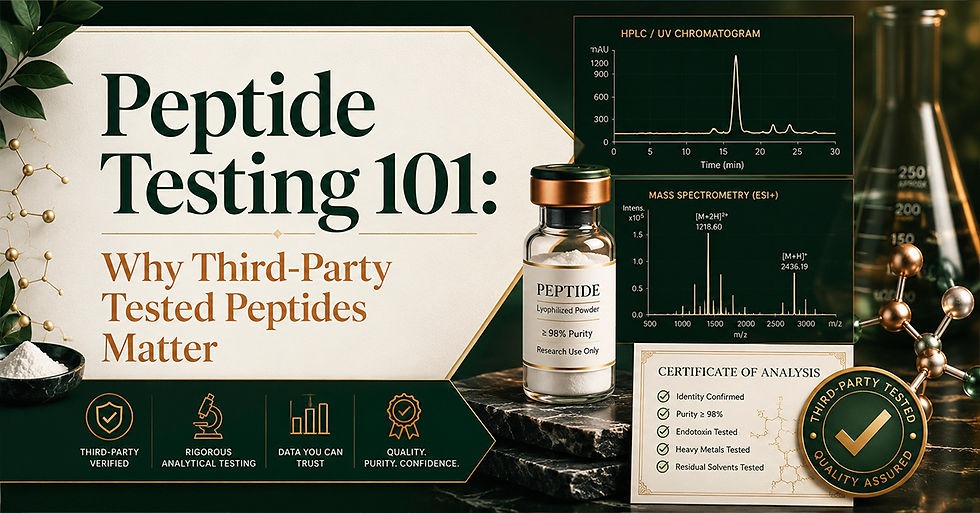
This is especially important because peptides are complex molecules. Even when a peptide name or sequence is listed, researchers still need meaningful data to confirm that the material aligns with the expected identity and quality profile. A robust third-party testing process helps answer key questions, such as whether the peptide is correctly identified. What is the reported purity? Was the material tested using appropriate analytical methods? Does the Certificate of Analysis match the lot being evaluated?
For research buyers, third-party testing can turn a product claim into a documented quality signal.
Why Third-Party Peptide Testing Is a Positive Quality Standard
Third-party testing is valuable because it separates quality documentation from marketing language. When an independent laboratory evaluates a peptide sample, the results can help support a more transparent relationship between supplier and researcher.
For reputable peptide suppliers, this is a major advantage. It shows that the company is willing to have its products reviewed by an outside lab rather than relying only on internal claims. In a market where quality, purity, and documentation matter, third-party testing helps demonstrate seriousness and professionalism.
A strong third-party peptide testing program may support:
Greater transparency
Batch-specific quality documentation
Better customer confidence
Clearer purity and identity verification
Stronger research-use documentation
More consistent quality-control expectations
A more professional buying experience
In short, third-party testing is not just a technical detail. It is a trust-building practice.
What Third-Party Testing Usually Checks
A well-documented peptide testing program often focuses on several major quality categories: identity, purity, composition, and contaminant screening. Different peptides and research applications may require different testing panels, but the goal is the same: to provide useful, traceable data.
1. Peptide Identity Testing
Identity testing helps confirm that the peptide being supplied matches the expected molecular structure. One of the most common tools for this is mass spectrometry, often listed as MS, MS/MS, or LC-MS.
Mass spectrometry can help confirm whether the measured molecular weight matches the expected peptide. For researchers, this is one of the most important pieces of documentation because it supports the basic identity of the material.
Helpful SEO terms: peptide identity testing, LC-MS peptide analysis, mass spectrometry peptide testing, molecular weight confirmation
2. Peptide Purity Testing by HPLC
High-Performance Liquid Chromatography, commonly known as HPLC, is one of the most recognized peptide purity testing methods. Analytical HPLC helps separate the main peptide from related impurities, degradation products, or other components.
This is where commonly reported purity numbers, such as 95%, 98%, or 99%, often come from. For customers, a batch-specific HPLC result can be a useful quality indicator because it shows that the peptide was evaluated using a recognized analytical method.
A supplier that provides HPLC purity data is giving customers more than a claim. They are giving them a measurable point of reference.
Helpful SEO terms: HPLC peptide purity testing, peptide purity analysis, analytical HPLC peptides, third-party peptide purity testing
3. Amino Acid Analysis
Amino Acid Analysis, or AAA, can help confirm the amino acid composition of a peptide. It may be used as an additional layer of verification when more detailed composition information is needed.
AAA does not replace mass spectrometry or HPLC, but it can support a broader analytical profile.
Helpful SEO terms: amino acid analysis peptides, peptide composition testing, AAA peptide analysis
4. Peptide Mapping and Structural Confirmation
For more advanced characterization, laboratories may use peptide mapping or related structural analysis tools. These methods can help support sequence verification and provide a deeper look at the material’s primary structure.
This type of testing may be especially helpful for more complex peptides or for research settings that require a higher level of documentation.
Helpful SEO terms: peptide mapping, peptide sequence verification, peptide structural analysis
5. NMR and Advanced Characterization
Nuclear Magnetic Resonance, or NMR, may be used for advanced structural evaluation. It is not always required for routine peptide testing, but it can be useful for complex materials, structural questions, or specialized research applications.
Helpful SEO terms: NMR peptide testing, peptide structural integrity, advanced peptide characterization
Specialized Quality Testing for Research Peptides
Depending on the peptide, format, and intended research use, additional testing may be helpful.
Endotoxin Testing
For certain research applications, especially cell-based assays or biologically sensitive workflows, endotoxin testing may be important. Endotoxins can interfere with research results, so testing for them can help support cleaner, more reliable experimental work.
When a supplier provides endotoxin testing where appropriate, it shows attention to research quality and assay compatibility.
Helpful SEO terms: endotoxin testing peptides, peptide endotoxin analysis, LAL peptide testing, research peptide quality
Residual Solvent Testing
Peptide synthesis and purification may involve solvents. Residual solvent testing helps evaluate whether solvent traces remain in the final material.
This type of testing can be an important part of a strong quality-control profile, especially for suppliers that want to provide more complete documentation.
Helpful SEO terms: residual solvent testing peptides, peptide contaminant testing, peptide manufacturing quality
Counter-Ion Analysis
Peptides are often supplied as salts, such as acetate or TFA forms. Counter-ion analysis can help identify and quantify the counter-ions present.
This can matter for research planning, solubility, formulation studies, and assay compatibility.
Helpful SEO terms: peptide counter-ion analysis, TFA peptide testing, acetate peptide salts
Solubility Testing
Some peptides dissolve easily, while others are more hydrophobic and may require special handling. Solubility testing can help researchers better understand how a peptide behaves under defined conditions.
Clear solubility information can support better research planning and more consistent experimental workflows.
Helpful SEO terms: peptide solubility testing, hydrophobic peptide testing, peptide reconstitution research
Stability Testing
Peptide stability testing evaluates how a peptide may change over time under certain conditions. Stability can be affected by temperature, light, moisture, pH, oxidation, and freeze-thaw cycles.
For peptide suppliers, stability-related data can help support better storage guidance and customer education.
Helpful SEO terms: peptide stability testing, peptide shelf life, peptide degradation testing, peptide storage conditions
How a Certificate of Analysis Builds Confidence
A Certificate of Analysis, or COA, is one of the most important documents connected to third-party tested peptides. A strong COA gives customers a clear snapshot of the testing performed on a specific batch or lot.
A useful peptide COA may include:
Product name
Peptide sequence or formula
Lot or batch number
Molecular weight
HPLC purity result
LC-MS or mass spectrometry identity confirmation
Appearance
Net peptide content, when applicable
Water content, when applicable
Residual solvents, when applicable
Counter-ion analysis, when applicable
Endotoxin testing, when applicable
Testing date
Laboratory information
For a peptide supplier, providing batch-specific COAs is a positive signal. It shows that the company values transparency and wants customers to have meaningful documentation before using materials in a research setting.
Third-Party Tested Does Not Mean FDA Approved — And That Distinction Matters
It is important to be clear: third-party testing is not the same as FDA approval.
A peptide may be third-party tested and still be labeled for research use only. Testing helps verify quality attributes such as identity and purity, but it does not establish that a peptide is approved for human use, medical use, or therapeutic application.
This distinction actually supports responsible communication. A trustworthy supplier can promote third-party testing as a quality and transparency measure while still making it clear that research-use peptides are intended for laboratory and educational purposes only.
That kind of clarity protects both the supplier and the customer.
Why Third-Party Testing Is Good for the Peptide Industry
Third-party testing helps move the peptide industry toward higher standards. It encourages suppliers to document quality, supports more informed purchasing decisions, and helps researchers better understand the materials they are working with.
For reputable peptide companies, this is good news. The more customers understand peptide testing, the more they can appreciate suppliers who invest in independent verification, transparent COAs, and batch-specific documentation.
Third-party testing helps raise the bar by rewarding companies that take quality seriously.
What Customers Should Look For
When reviewing third-party tested peptides, customers should look for clear documentation rather than vague claims. A strong supplier should be able to provide testing details that connect directly to the product and batch being evaluated.
Positive signs include:
Batch-specific COAs
HPLC purity data
LC-MS or mass spectrometry confirmation
Clear testing methods
Lot number traceability
Additional testing when relevant
Transparent research-use-only language
Consistent product documentation
These are all signs of a supplier that understands the importance of trust and research quality.
Final Takeaway
Peptide Testing 101 starts with one simple idea: quality should be documented. For peptide suppliers, third-party testing is one of the strongest ways to show transparency, build customer confidence, and support responsible research-use standards.
Methods such as HPLC, LC-MS, mass spectrometry, amino acid analysis, peptide mapping, capillary electrophoresis, NMR, endotoxin testing, residual solvent testing, counter-ion analysis, solubility testing, and stability studies all help create a clearer quality picture.
For researchers and buyers, third-party testing helps turn trust into documentation. For peptide suppliers, it shows a commitment to doing things the right way.
In a growing peptide research market, that kind of transparency is not just helpful. It is essential.
Editor’s Note: This article is intended solely for research, educational, and industry discussion purposes. It does not promote, recommend, or imply any personal use, medical use, health benefit, treatment outcome, or therapeutic application of peptides or related compounds.


Comments